
Running a multi-market campaign from a global headquarters is operationally complex. Assets multiply across markets. Approval chains stall. Budgets disappear into agency invoices with no clear breakdown. And somewhere in the middle of it all, teams are switching between translation portals, project management tools and email chains trying to piece together a coherent picture. For many enterprise teams, finding the best localisation management platforms is what stands between that chaos and a workflow they can actually control.
Localisation management software refers to platforms that help enterprise teams plan, execute, review and deliver content across multiple languages, markets and channels. These tools range from traditional translation management systems (TMS) to end-to-end workflow orchestration platforms built for the full creative adaptation lifecycle.
This guide reviews the best localisation management platforms options for enterprise teams in 2027 covering what each platform does, who it suits and where its limitations lie.
What Is an Enterprise Localisation Management Platform?
Enterprise localisation goes well beyond translating text. A single multi-market campaign can involve global brand teams, creative agencies, local market reviewers, linguists, designers, production partners and multiple technology platforms all needing to work together without losing context, version control or budget visibility.
The right software needs to handle that complexity. Translation accuracy matters, of course. However, for enterprise teams, the more pressing challenges are operational: fragmented workflows, disconnected tools, hidden costs and the lack of a single view across the entire content adaptation lifecycle.
That is why the category has evolved. Traditional TMS platforms manage the linguistic layer well. However, modern enterprise teams increasingly need something broader a platform that connects tools, teams and workflows into one coherent operating environment.
The Best Localisation Management Platforms for Enterprise Teams: What to Look for
Before evaluating specific platforms, it is worth establishing what enterprise-grade localisation management actually requires. The following criteria matter most for global teams operating at scale:
Tech-agnostic connectivity. The platform should connect via APIs to your existing CMS, DAM, PIM and project management tools without requiring you to replace them.
Granular financial visibility. Procurement leads need real-time dashboards showing spend by market, language and service type. Bundled agency invoices are not sufficient at enterprise scale.
Multimedia support. Modern campaigns involve video, visual assets, voiceover and digital advertising not just text. The platform needs to handle the full content adaptation lifecycle, not just the linguistic layer.
Unified talent and vendor management. Internal teams, external agencies and freelance linguists should be coordinated within a single workspace not across email chains and separate portals.
Service-led implementation. Enterprise deployments involve significant change management. Platforms that simply hand over a login create friction. Those that partner on setup and adoption reduce it.
The Best Localisation Management Platforms in 2027
We have reviewed the leading platforms across the enterprise localisation landscape from established TMS providers to workflow orchestration layers built for complex global marketing operations.
1. Adaptria
Adaptria is not a translation management system. That distinction matters and it is what sets it apart from every other platform in this guide.

Adaptria is a workflow orchestration platform built specifically for enterprise global content adaptation. Rather than managing the linguistic layer itself, it connects and orchestrates the tools, teams, workflows and budgets that do routing briefs, assets, approvals and people through a single unified system, from initial brief to final delivery.
Best for: Enterprise teams managing complex, multi-market content adaptation across multiple tools, agencies and creative workflows
Key features:
- Tech-agnostic API orchestration connecting tools like Phrase, Crowdin, Asana, Adobe Workfront and DAM platforms into one pipeline
- Real-time financial reporting and spend visibility across markets, languages and service types eliminating the agency “black box”
- End-to-end multimedia workflow coverage: transcreation, visual asset versioning, Performance Linguistics®, video adaptation and beyond
- Intelligent resource routing across automation, nearshore resource and in-market expertise
- Service-led implementation with hands-on change management support
Limitations: Adaptria is built for operational complexity. The more markets, tools and stakeholders involved, the more value it delivers. Teams with straightforward, single-language localisation needs are likely better served by a standalone TMS.
Pricing: Pricing on request. Book a demo to get a quote
If your enterprise is managing several of the tools listed in this guide, Adaptria is how you make them work together as one connected operation. See how workflow orchestration works →
2. Smartling
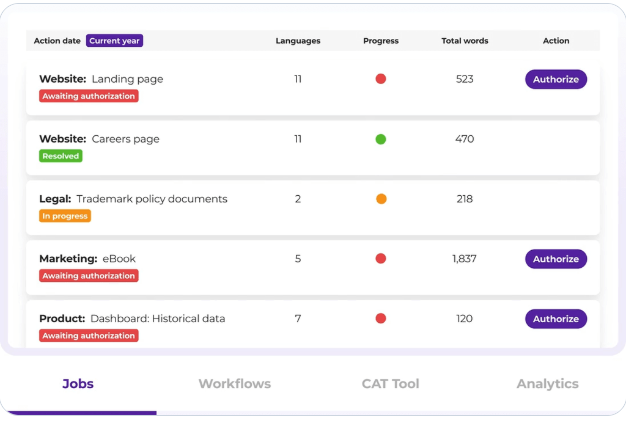
Smartling is a well-established enterprise TMS used by major global organisations to automate translation pipelines. It combines translation memory, AI-assisted translation and a managed language services layer within a single platform.
Best for: Enterprise teams managing high-volume text translation with integrated language services
Key features:
- Visual context tools that let linguists see how copy renders on live web pages
- Website translation proxy technology (Global Delivery Network)
- Translation memory and AI-assisted translation workflows
Limitations: Smartling is primarily focused on text translation and traditional TMS workflows. It is not built for complex creative adaptation, multimedia content or broader marketing campaign orchestration. Additional tools are typically needed alongside it.
Pricing: Pricing on request.
3. Phrase
Phrase is a translation management suite with strong AI localisation features, widely used by in-house localisation teams and digital agencies. It integrates directly with code repositories and content platforms, making it a popular choice for tech-forward organisations.
Best for: Localisation managers and digital teams handling structured content at volume
Key features:
- AI-powered machine translation with multiple engine options
- Translation memory leverage and terminology management
- Direct integrations with GitHub, GitLab and major CMS platforms
Limitations: Phrase is built for the linguistic layer. It does not cover creative adaptation, visual asset management or multicultural workflows. For enterprise marketing teams managing full campaign adaptation, it works best as one component within a broader operational system.
Pricing: From approximately £17/month for smaller teams. Enterprise pricing on request.
4. Lokalise
Lokalise has gained traction among digital product teams for its clean interface and strong design-stage integrations. It connects directly with Figma and Adobe XD, allowing localised copy to be tested inside design prototypes before assets go to development.
Best for: Digital product and software teams localising apps, platforms and digital interfaces
Key features:
- Figma and Adobe XD integrations for design-stage localisation
- Developer-friendly SDKs and CLI access
- Automated workflow triggers and over 50 pre-built integrations
Limitations: Lokalise is optimised for product and software localisation. Enterprise brands managing broad marketing campaigns across print, paid media, video and multiple creative channels are likely to outgrow its scope.
Pricing: From approximately £120/month. Enterprise pricing on request.
5. Crowdin
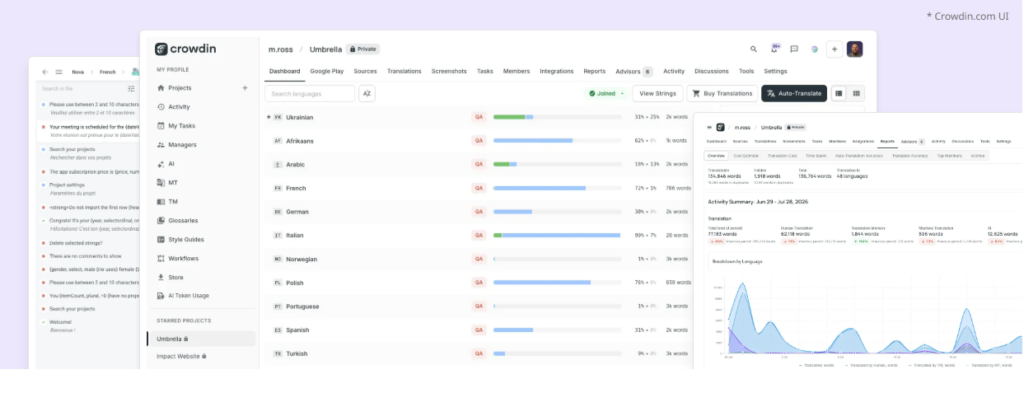
Crowdin is an AI-powered localisation platform supporting over 100 file formats, making it highly versatile for technical teams managing diverse content types. It offers extensive automation rules and a large library of pre-built integrations.
Best for: Technical and product teams managing diverse file types and developer-led localisation workflows
Key features:
- Support for 100+ file formats
- Extensive automation rules and workflow configuration
- AI translation with customisable quality profiles
Limitations: Crowdin requires technical configuration to get full value from its features. Non-technical brand and marketing managers may find the setup steep. It is also primarily text and product-focused rather than built for multimedia marketing adaptation.
Pricing: Free tier available. Paid plans from approximately £22/month. Enterprise pricing on request.
6. memoQ
memoQ is a professional translation environment widely used by language service providers and enterprise in-house translation teams. It offers powerful terminology management, translation memory and quality assurance tools, with a strong reputation among professional linguists.
Best for: In-house translation teams and language service providers managing high-accuracy linguistic workflows
Key features:
- Advanced translation memory and terminology management
- Detailed quality assurance and linguistic review workflows
- Strong support for regulated and high-accuracy content types
Limitations: memoQ is built for the linguistic layer. It is not designed for marketing campaign orchestration, creative adaptation or multimedia content. It works well as a specialist translation environment but enterprise marketing teams need additional infrastructure around it.
Pricing: From approximately £120/year for individual licences. Enterprise pricing on request.
7. Transifex
Transifex is a cloud-based localisation platform popular with software companies and digital-first brands. It supports continuous localisation workflows and integrates directly with development pipelines, making it well suited to agile product teams.
Best for: Software companies and digital-first brands running continuous localisation alongside product development
Key features:
- Continuous localisation with direct developer integrations
- AI-assisted translation and translation memory
- Integrations with Slack, Jira, GitHub and content platforms
Limitations: Transifex is primarily built for software and digital product localisation. Enterprise marketing teams managing creative adaptation, multimedia content and complex multi-agency workflows will find it limited in scope.
Pricing: Pricing on request.
Want to Understand the Operational Problems First?
If your team is experiencing slow multilingual content delivery and you want to understand the root causes before evaluating tools, our guide covers the most common operational bottlenecks and four practical fixes for each.
Read: How to Speed Up Multilingual Content Delivery for International Campaigns →
How to Choose the Right Platform for Your Enterprise Operations
The right platform depends on where your operational bottleneck actually sits.
If your core need is text translation at volume, established TMS platforms like Smartling, Phrase or memoQ are strong choices. They offer mature linguistic infrastructure, translation memory and human review workflows.
If you are managing digital product or software localisation, developer-centric platforms like Phrase, Lokalise, Crowdin or Transifex integrate well with technical pipelines and agile development cycles.
If you are managing complex, multi-market marketing campaigns with multiple agencies, multimedia assets, creative adaptation rounds and limited budget visibility a standalone TMS will not be sufficient. What your enterprise needs in that case is an orchestration layer that connects your existing tools and gives leadership end-to-end control.
That is the gap Adaptria is built to fill.
Comparison Table
| Adaptria | Enterprise marketing orchestration | Yes full lifecycle | Yes tech agnostic | Yes real time | On request |
| Smartling | Enterprise text translation | Limited | Yes | Limited | On request |
| Phrase | Localisation teams, digital content | Limited | Yes | Limited | From ~£17/month |
| Lokalise | Digital product localisation | No | Yes | No | From ~£120/month |
| Crowdin | Technical / developer teams | No | Yes | No | From ~£22/month |
| memoQ | Professional translation teams | No | Partial | No | From ~£120/year |
| Transifex | Software / continuous localisation | No | Yes | No | On request |
FAQs
What is localisation management platform?
Localisation management software helps organisations plan, execute, review and deliver content across multiple languages, markets and channels. It ranges from translation management systems (TMS) that handle linguistic workflows to orchestration platforms that manage the full content adaptation lifecycle including creative adaptation, multimedia content and financial reporting.
What is the best localisation management platform for enterprise teams?
The right choice depends on your operational needs. Teams managing text-heavy translation workflows rely on well-established options like Smartling and Phrase, while digital product localisation teams tend to favour Lokalise and Crowdin.. For enterprise teams managing complex, multi-market marketing campaigns across multiple tools and agencies, Adaptria provides the orchestration layer that connects the full operation.
How is an orchestration platform different from a TMS?
A translation management system (TMS) manages the linguistic layer translation memory, terminology, human review and delivery of translated text. An orchestration platform sits above that layer, connecting the TMS and other tools (DAMs, project management platforms, creative tools) into a single workflow and managing the movement of work, people and budgets across the full content adaptation lifecycle.
Do enterprise localisation platforms work with existing tools?
The best enterprise platforms connect to your existing tech stack via APIs rather than replacing it. Adaptria, for example, can integrate with tools like Adobe Workfront, Phrase, Crowdin, Asana and DAM platforms so your teams continue working in the tools they know, while gaining a connected operational view across all of them.
What should enterprise teams look for in a localisation platform?
Enterprise teams should prioritise tech-agnostic connectivity, real-time financial visibility, multimedia content support, unified talent and supplier management, and service-led implementation. Generic project management tools and basic translation portals are rarely sufficient for complex, multi-market operations at scale.
The Bottom Line
The best enterprise localisation management platforms in 2027 depends entirely on the complexity of what you are managing. Text-focused TMS platforms serve linguistic workflows well. Developer-centric tools handle product and software localisation effectively. However, for enterprise brands managing full creative adaptation at scale across multiple markets, agencies, tools and budgets the missing piece is usually not another point solution. It is an orchestration layer that makes everything else work together.
That is precisely what Adaptria is built to provide.
Ready to connect your localisation tools into one unified operation? Book a free demo →
Adaptria, a Locaria technology, is the operating platform for global content adaptation purpose-built for the complexity of multilingual marketing at scale.