Global content teams rarely describe their workflow as fragmented. Campaigns launch. Markets receive assets. Agencies deliver project files. Internal teams approve content.
From the outside, the operation appears functional. But inside many organisations, content adaptation still moves through disconnected systems, manual approvals, and repeated handoffs that make delivery slower and costlier than it needs to be.
The issue is not whether work gets done. It is how much hidden coordination is required to keep it moving.
“Fragmented content adaptation workflows slow global delivery because assets, localisation, approvals, and market feedback often happen in separate systems without one operational layer connecting them.”
What Is a Fragmented Content Adaptation Workflow?
A fragmented content adaptation workflow happens when content moves across multiple tools, teams, and approval channels without one connected process governing the full journey.
In many global teams, this looks like:
- source assets managed in one platform
- localisation requests sent through email
- translated files returned by agency partners through another tool
- approvals tracked in spreadsheets
- local edits shared in separate documents
- final versions stored elsewhere
Each tool supports one part of the work. The problem is that no single system governs how the parts connect.
What causes fragmented workflows in global content operations?
Fragmented workflows happen when transcreation, creative adaptation, approvals, collaboration, and delivery are managed in separate systems, forcing teams to manually connect each stage.
That manual/disjointed coordination becomes harder as campaign volume increases.
Why Do Fragmented Workflows Affect Global Campaign Delivery?
Fragmented workflows affect delivery because every handoff introduces uncertainty.
Teams pause to check:
- which version is latest
- whether language edits were approved
- who still needs sign-off
- whether local feedback changed the file again
A global FMCG team preparing campaign assets for eight markets may complete master creative on time, but adaptation slows when:
- Spanish copy arrives before legal review finishes
- Germany requests packaging edits separately
- France approves an earlier design file version
- Regional stakeholders reply through email instead of the review system
The launch is in motion, but coordination expands dramatically.
What should be one campaign becomes eight slightly different workflows eating up time and effort.
Why this matters operationally
The delay often does not come from adaptation itself, it comes from the time spent reconciling what changed, where, and whether everyone is working from the same version.
In global adaptation, workflow delay usually happens between systems, not inside one task.
How Do Fragmented Approvals Affect Multilingual Campaigns?
Approvals are often where hidden delay becomes most visible. A campaign may require:
- brand approval
- legal approval
- language review
- local market validation
- publishing sign-off
If each happens in separate channels, visibility disappears. This creates duplicate reviews, conflicting edits, and delayed launch readiness.
A small change creates a full cycle repeat.
What Is the Best Workflow for Global Content Adaptation?
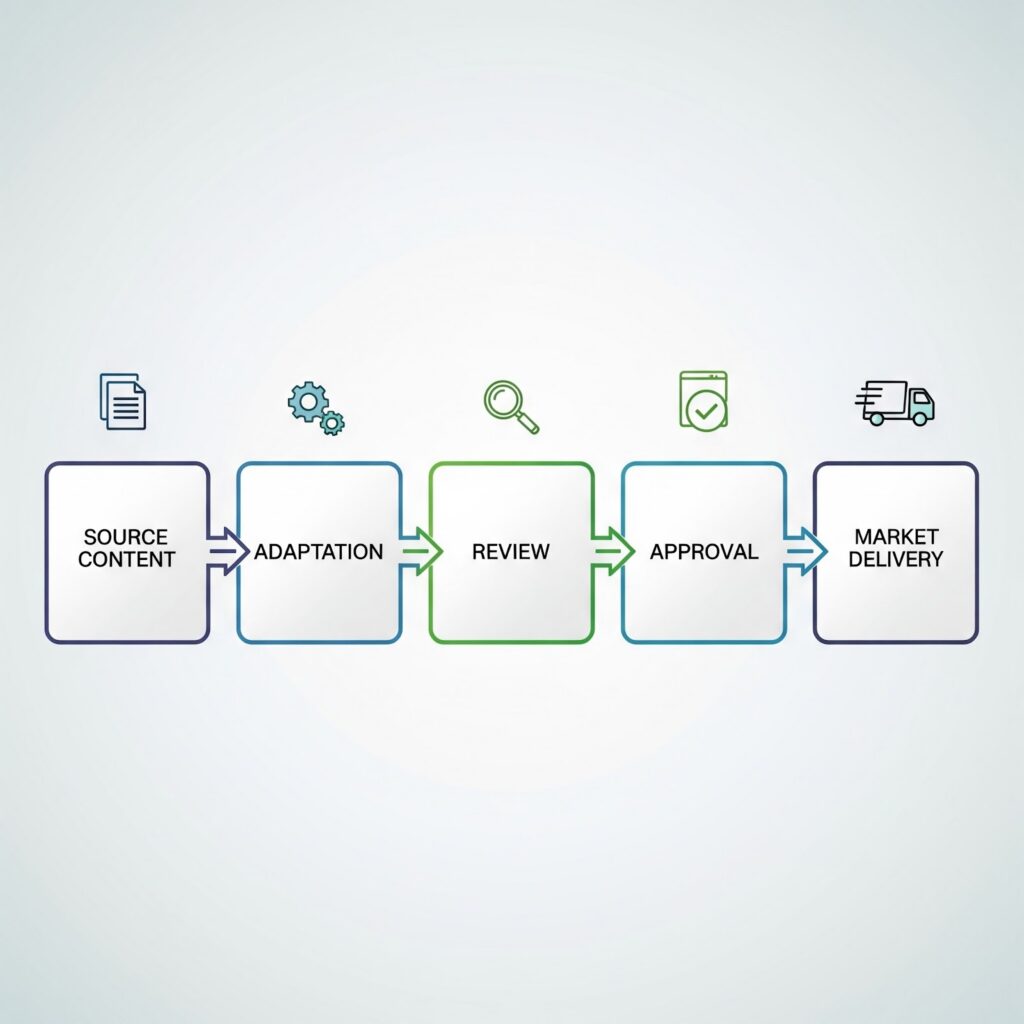
The most effective workflow is one where every stage connects operationally. That means teams can immediately see:
- what is in progress
- what is blocked
- what is approved
- what is waiting for market action
- what is ready for release
When this chain is visible, teams spend less time coordinating manually.
A scalable workflow should allow teams to:
- manage asset versions centrally
- assign ownership clearly
- monitor approval status live
- reduce repeated briefing
- keep market feedback connected to source files
How Adaptria Solves the End-to-End Workflow Problem
Adaptria is built for the part of content adaptation that most existing systems do not fully control: the movement of work between teams, tools, and approval stages.
In many global workflows, the biggest delays do not happen inside transcreation or asset adaptation themselves. They happen between steps — when one team is waiting for another, when files move outside the main system, or when approvals happen separately from the content they affect.
Adaptria brings those disconnected stages into one operational flow.
Instead of managing localisation, approvals, and delivery as separate activities, teams can run them as part of one connected process where each stage is visible in context.
What changes in practice
A campaign asset enters one workflow where teams can:
- follow adaptation requirements by market, language, service etc.
- forward assets and briefs together without separate manual briefing
- manage stakeholder reviews against the correct version in one view
- capture approval status without chasing updates across email
- track what is market-ready and what is still blocked
This means teams no longer have to reconstruct progress across multiple systems just to understand what happens next.
Why orchestrated global content workflows matters beyond visibility
The real advantage is not simply seeing status. It is reducing the operational friction that appears every time responsibility changes hands.
For example:
- A local market reviewer can comment directly within the workflow instead of sending separate feedback.
- Resources allocation can be tracked by language, market, and client services
- A delayed approval becomes visible before it affects launch timing.
- A content update stays connected to the version already under review.
That reduces repeated work and prevents small delays from becoming launch bottlenecks.
Why Adaptria is different from other global content tools
Most tools improve one function:
- translation management systems manage linguistics
- DAM systems manage storage
- project management tools manage task lists
- Design tools focus on the creative assets
However, Adaptria sits across those functions to help global teams manage how work moves end-to-end.
If your current process still depends on spreadsheets, separated tools, email approvals, and separate status checks across teams, the issue may not be effort — it may be workflow design.
Explore how Adaptria helps global teams run content adaptation with more control from source asset to market delivery. Explore now for FREE